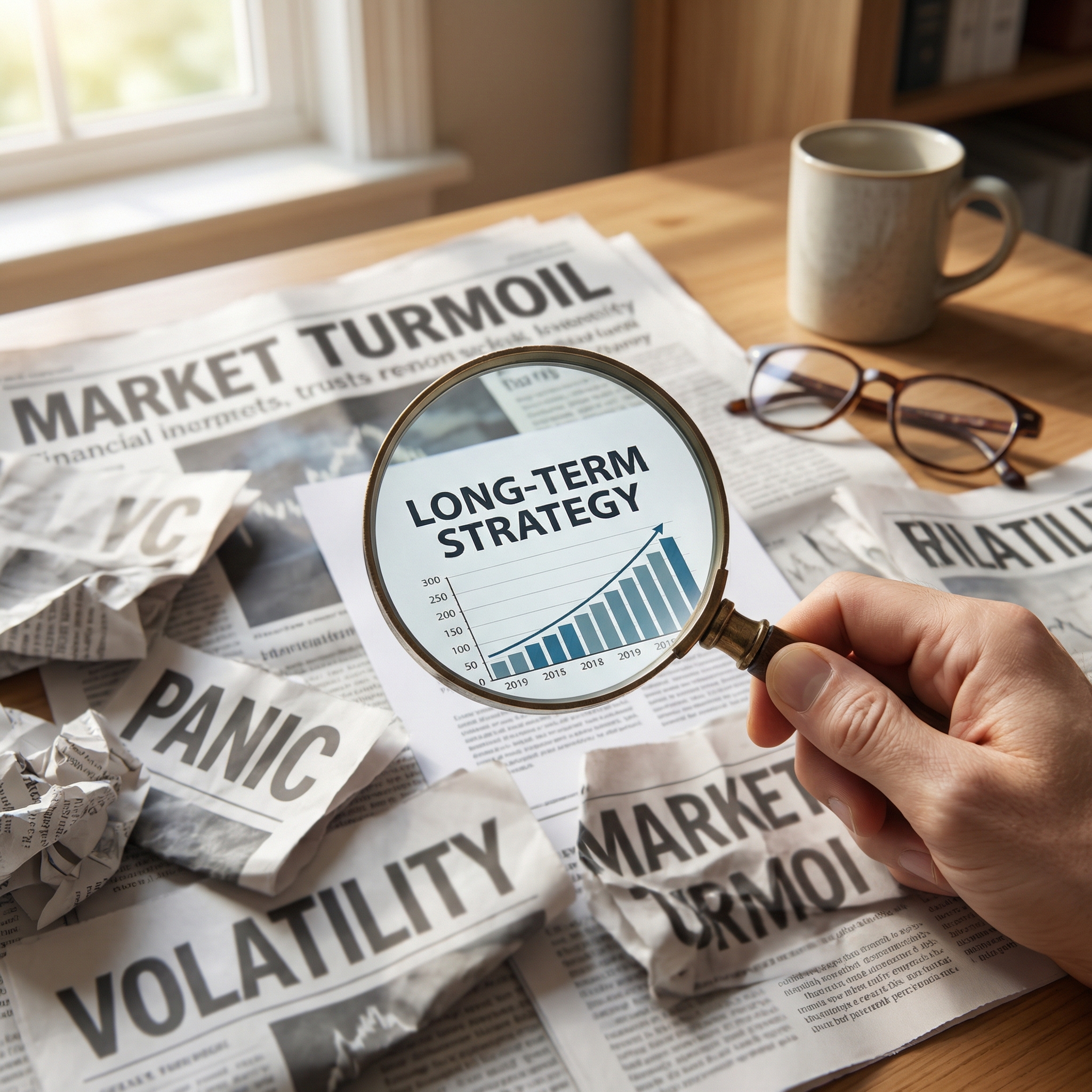
When Market Headlines Feel Louder Than Your Plan
Markets rarely move in straight lines, yet the combination of price swings and 24-hour financial news can make volatility feel like an emergency. For many investors, the emotional impact of a sharp market move is amplified by dramatic language, breaking alerts, and endless commentary. Wealth management professionals see this pattern repeatedly, not because clients lack intelligence, but because our brains are wired to react quickly to perceived danger. In reality, short-term market turbulence and breathless news coverage often say very little about your long-term financial trajectory. The challenge is learning to separate market noise from meaningful signals so your portfolio serves your goals instead of your fears.
Misconception 1: Volatility Means Your Portfolio Is Failing
One of the most common misunderstandings is the idea that volatility itself is evidence of a bad portfolio or poor advice. Volatility simply measures how much prices move up and down over a given period; it does not tell you whether an investment is appropriate for your objectives or time horizon. A diversified portfolio built for long-term wealth will still experience temporary declines when markets reset, reprice risk, or react to new information. Those fluctuations can feel uncomfortable, but discomfort is not the same as permanent loss. Permanent loss usually occurs when an investor sells quality assets at depressed prices, locking in declines that might otherwise have recovered over time.
Wealth managers expect volatility and design portfolios to survive it, not eliminate it completely. Equity exposure, alternative strategies, and even high-quality bonds will all exhibit some degree of price movement in different market regimes. Instead of treating every downturn as a verdict on your entire strategy, it is more useful to ask whether current volatility falls within the normal range anticipated when your plan was created. If the answer is yes, the portfolio is functioning as intended, even if the experience feels unsettling. If it falls outside those expectations, then it becomes a data point for thoughtful review, not a trigger for impulsive action.
Misconception 2: Moving to Cash During Turbulence Protects Your Wealth
When markets feel chaotic, moving everything to cash can seem like the only rational form of self-defense. The reasoning sounds straightforward: if prices are falling, just step aside until things calm down. The hidden problem is that markets do not send clear invitations to get back in, and many of the strongest up days historically have clustered around periods of intense volatility. Sitting in cash may avoid part of a downturn, but it also risks missing a meaningful portion of the recovery that often begins quietly, long before headlines turn optimistic. In addition, inflation steadily erodes the purchasing power of cash, which can be especially damaging to multi-decade financial plans.
A thoughtful wealth management strategy acknowledges the role of cash without turning it into an emotional refuge. Cash reserves for short-term needs, upcoming expenses, or planned opportunities can be built deliberately, not in reaction to the latest scare. For long-term assets, a more disciplined approach is to maintain an allocation range and rebalance when markets move significantly. During selloffs, that may mean trimming relatively resilient holdings and buying those that have declined, a process that feels uncomfortable in the moment but supports long-term compounding. Instead of an all-or-nothing rush to cash, you end up with a measured framework that respects both risk and opportunity.
Misconception 3: Every Headline Demands a Portfolio Change
Financial news is designed to be consumed frequently, not to manage your net worth responsibly. Networks and websites compete for attention through immediacy, urgency, and strong opinions, which encourages the belief that every development is a turning point. If you respond to that narrative, your portfolio can become a reflection of the news cycle instead of your actual goals. That leads to constant tinkering, higher transaction costs, and a portfolio that is always catching up to yesterday’s story. Over time, reacting to each headline can be more damaging than the market volatility that triggered the headline in the first place.
Wealth planning puts the news into context by filtering events through your specific objectives and time frames. A central bank announcement, an earnings miss, or a geopolitical shock will absolutely move markets in the short run, but the question is whether it truly alters your long-term assumptions. Advisors often translate breaking news into a simple decision tree: does this event materially change your cash flow needs, your required rate of return, or the fundamental case for the asset classes you own. If the answer is no, the appropriate response is usually monitoring, not wholesale change. This shift from reflex to framework allows you to watch the news without granting it authority over every investment decision.
Misconception 4: Professionals Can Reliably Trade Every Market Swing
Another powerful misconception is the belief that professional investors, or your advisor, should be able to sidestep every drop and participate in every rally. This expectation is reinforced by stories about famous managers who called a particular crisis or bull market correctly. What those stories rarely highlight is the long list of experts who were early, late, or wrong altogether, or the difficulty of repeating such timing consistently. Even full-time institutional investors operating with sophisticated tools acknowledge that predicting short-term moves with precision is extremely challenging. Wealth management aims for robust outcomes over entire market cycles, not perfection in every single quarter.
Instead of promising clairvoyance, a disciplined advisory process emphasizes diversification, risk management, and scenario planning across different environments. That means accepting that some allocations may lag in certain phases while contributing meaningfully in others, which is a natural tradeoff of building resilience. Advisors will adjust positioning when valuations, fundamentals, or client circumstances shift enough to justify change, but they do so through measured reallocation rather than constant trading. The goal is to keep you close enough to market growth to meet your objectives while reducing the odds that a single shock disrupts your entire plan. In this framework, success is defined by progress toward financial independence, not by winning every short-term guessing contest.
Misconception 5: Risk Is One Number You Either Accept or Reject
Many investors think of risk as a single, fixed number, often expressed as a conservative, moderate, or aggressive label. In practice, risk is multi-dimensional and deeply personal, especially during volatile markets. There is market risk, which shows up as price swings, but also income risk, liquidity risk, concentration risk, and the risk of not growing assets fast enough to support your desired lifestyle. A portfolio that feels comfortable in calm markets may test your tolerance when the swings become larger and more frequent. Wealth management is not about eliminating risk entirely, but about choosing which risks you are willing to own and which you prefer to avoid.
Effective financial planning breaks risk into components that can be measured, discussed, and aligned with real-world decisions. That may include setting guardrails on maximum drawdowns, diversifying away from a single company or sector, or building a buffer of stable assets for known upcoming expenses. During turbulent periods, this structure makes it easier to distinguish between acceptable volatility and risk that has grown beyond your comfort zone. Instead of asking vaguely whether markets feel “too risky,” you and your advisor can evaluate whether each element of your risk profile still supports your long-term objectives. When adjustments are needed, they are made deliberately, not as a reflexive response to the latest market scare.
Practical Ways to Stay Grounded During Volatile News Cycles
Staying calm amid volatility is easier when you have concrete practices, not just good intentions. The goal is to create a decision environment in which thoughtful choices are more likely than impulsive reactions. Integrating a few simple habits into your wealth management routine can dramatically change how you experience turbulent markets.
- Schedule portfolio reviews on a regular calendar, rather than when headlines spike, so evaluations are consistent and less emotional.
- Agree in advance with your advisor on what truly warrants changes, such as major life events or structural shifts in your financial situation.
- Set boundaries on how much market news you consume, focusing on high-quality analysis instead of constant real-time commentary.
Volatile markets and intense news cycles are unavoidable features of modern investing, but they do not have to dictate your financial story. When you replace misconceptions with a clearer understanding of volatility, risk, and the role of information, your decision-making becomes calmer and more intentional. Wealth management is most effective when it acts as a buffer between your emotions and your capital, translating uncertainty into actionable strategy. By committing to a structured plan and a thoughtful process for interpreting news, you allow short-term market noise to fade into the background. In the long run, that discipline can be just as valuable as any specific investment selection in building and preserving your wealth.